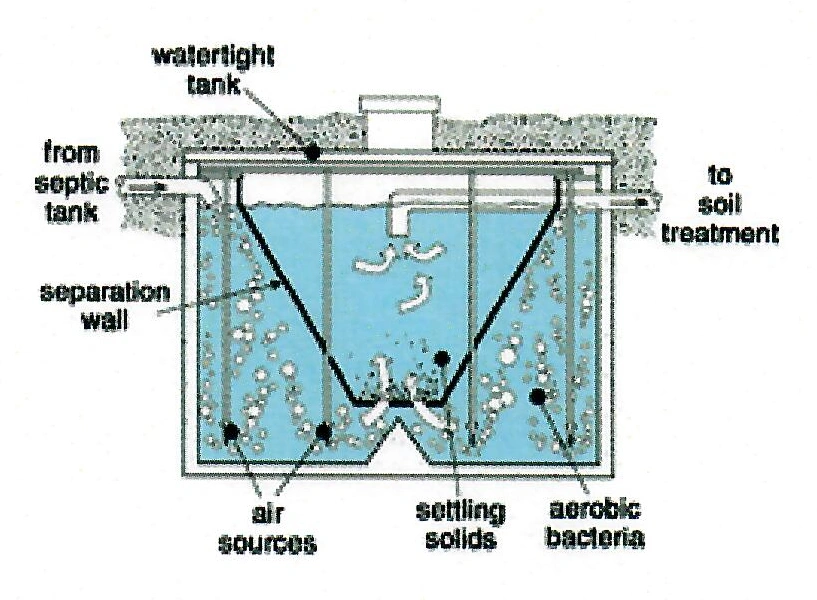
Suspended Growth ATU
The most common household ATU is the suspended growth. These units have a main treatment chamber where bacteria are free-floating and air is bubbled through the liquid. The second chamber where the solids settle out is separated from the main tank by a wall or baffle. The two chambers are connected at the bottom or by a pump, and settled bacteria from the second chamber are brought back into the main treatment chamber. It is this process of return and mixing that is important for effective operation.
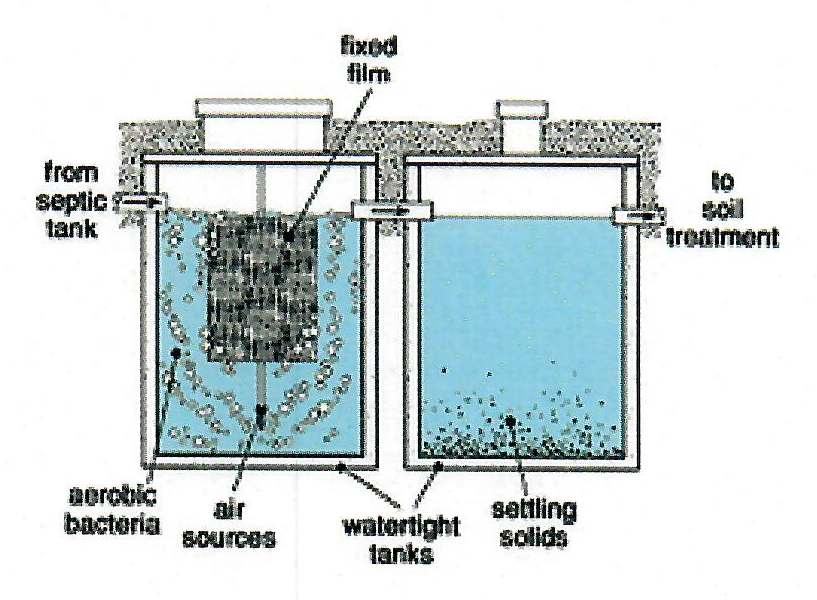
Fixed-Film Reactor ATU
A fixed-film reactor has bacteria growing on a specific surface medium and air is provided to that part of the tank. The bacteria can grow on any surface including fabric, plastic, styrofoam, and gravel. Decomposition is limited to this area, and settling occurs in a second chamber. This design is expensive, but the effluent is of consistently high quality. There is no need for a return mechanism because the bacteria stay on the film.
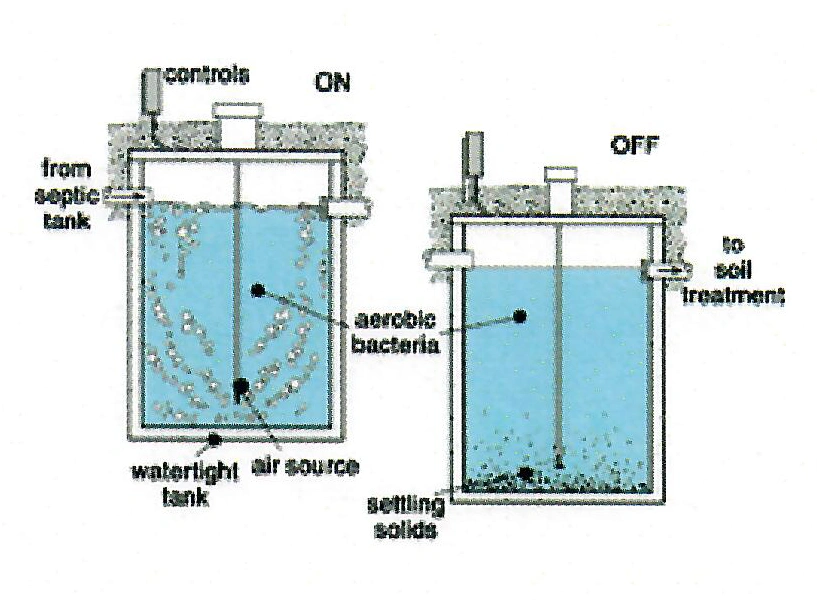
Sequencing Batch Reactors ATU
In sequencing batch reactors (SBR), aerobic decomposition, settling, and return occur in the same chamber. Air is bubbled through the liquid during the decomposition cycle. The bubbler shuts off, and the wastewater goes through a settling cycle. Once the bubbler turns back on, the tank re-enters the decomposition cycle, and settled bacteria mixes back into the aerobic environment. After settling of bacteria and solids, the treated effluent is discharged to the soil treatment system. Bacteria settle out more consistently in this kind of tank, but since it has more moving parts and requires a controller, it has more potential for mechanical and electrical failure.